
Challenge your assumptions: how LCA reveals the true impact of packaging
 By Barbara Nebel, thinkstep-anz.
Demand for more sustainable packaging is rising across the food sector. Consumers want to buy ‘greener’ choices. Retailers are tightening expectations. Regulators are increasing scrutiny.
For food brands, the focus is on avoiding costly packaging changes, protecting market access and making claims that can stand up to scrutiny. Decisions on packaging changes are not taken lightly.
But what is perceived as environmentally friendly is not always the option that reduces impact. Paper can feel like the safer choice. Compostable packaging can sound like the lower-impact option. Plastic is often assumed to perform poorly from an environmental perspective.
In reality, packaging impacts are rarely that simple.
Packaging impact is easy to misread
Packaging choices affect more than waste. They can influence transport emissions and food waste too. Looking at recyclability or compostability alone can miss the biggest impacts.
For example:
- Heavier packaging can increase transport emissions across Australia’s long supply chains.
- Compostable packaging may not deliver benefits if there is no collection or processing infrastructure to support it.
- Packaging that reduces shelf life can increase food waste, which can outweigh the impact of the packaging itself.
For food brands, this matters. Packaging is not just a wrapper. It is part of the whole product system.
How Life Cycle Assessment helps
With retailers, regulators and consumers scrutinising environmental claims, assumptions aren’t just risky – they threaten market access. This is why evidence, rather than intuition, is essential.
This is where Life Cycle Assessment (LCA) comes in. It is a tool that measures environmental impact across a product’s full life cycle – from raw materials and manufacturing to use and disposal. It considers inputs like energy, materials and transport, and outputs like emissions, waste and pollution.
LCA answers the crucial question: Which packaging choice reduces environmental impact when the whole system is considered?
For food products, this system view is critical. Packaging protects food safety, maintains quality and extends shelf life. If packaging fails to perform these functions, food waste increases, and that can outweigh differences between packaging materials.
When evidence challenges assumptions
Packaging LCAs often deliver unexpected results. In a study carried out for New Zealand Post New Zealand Post, recycled LDPE courier bags outperformed paper and compostable alternatives when assessed across the full life cycle. The lightweight design reduced material use and transport impacts, even though plastic is often assumed to be worse based on disposal alone.
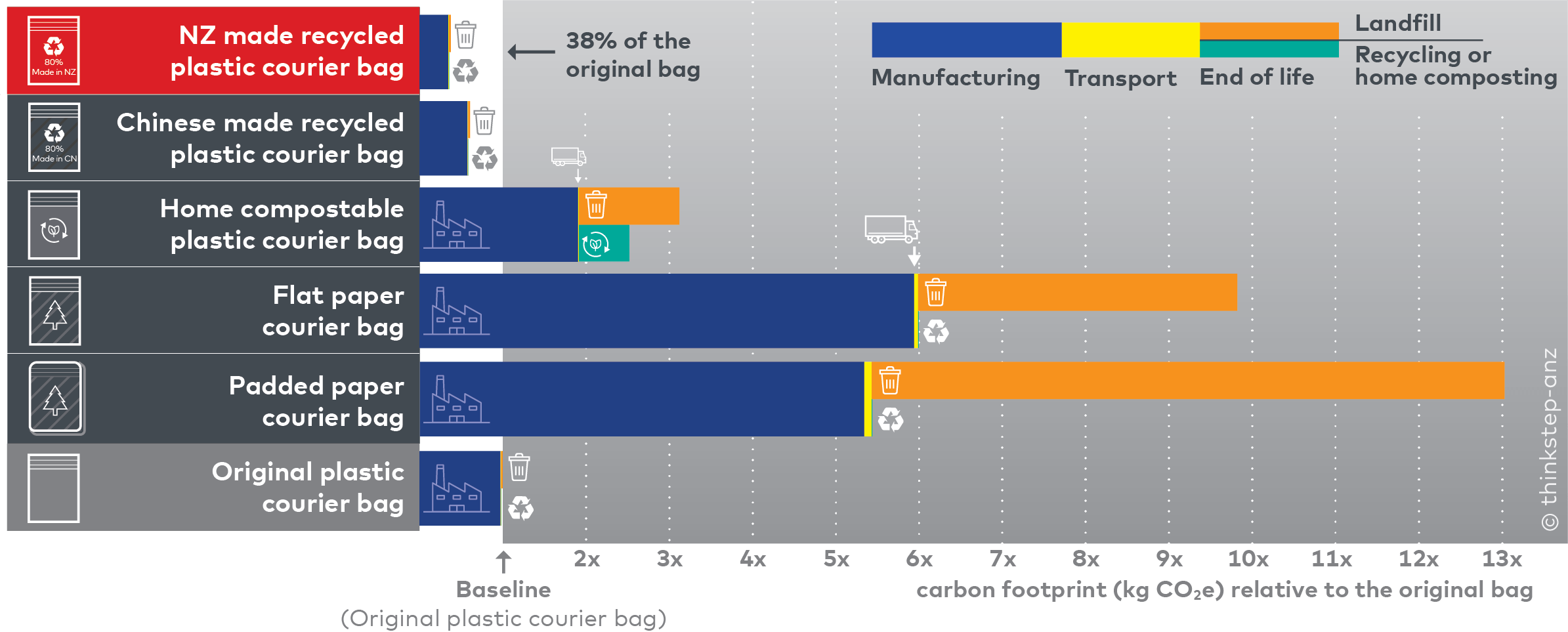
Source: NZ Post Nutshell report
While this case study is not from the food sector, the lesson is highly relevant: lightweight packaging can outperform heavier alternatives once transport, manufacturing and end-of-life are considered.
Similarly, a recent LCA we carried out for Tetra Pak Oceania found that lightweight cartons had the lowest carbon footprint over their life cycle among the packaging formats assessed. The study found that on average, more than 95 percent of emissions come from producing consumer packaging. The end-of-life stage contributes only about 2 percent to a package’s total carbon footprint. Glass, aluminium and most plastics require more energy to make. Cartons perform better because they use fewer resource-intensive materials and have a high share of renewable paperboard.
In food systems, packaging also plays a critical role in reducing spoilage. Even small changes in shelf life can have a bigger environmental impact than switching materials.
For food brands, these insights are critical. These results do not mean one material is always better. They show that performance depends on the full system, not on perception.
What this means for food brands
For food manufacturers, packaging decisions affect:
- distribution efficiency across long transport distances
- refrigeration requirements
- product damage rates
- shelf life performance
- food waste outcomes
- the credibility of environmental claims
LCA helps identify where changes will have the most meaningful impact. Sometimes that involves changing materials. In other cases, it means reducing weight, improving design or extending shelf life.
It also helps teams understand trade-offs and explain decisions clearly to retailers, regulators and customers.
Evidence builds credibility
Environmental claims are under increasing scrutiny in Australia and in export markets. Brands that rely on assumptions risk reputational damage or challenges from retailers and regulators.
As expectations tighten, brands need to be able to explain why a packaging choice was made, and what impact it is expected to reduce. LCA helps teams avoid vague claims and back up messaging with evidence.
LCA provides an evidence base for packaging decisions and for external communication. Verified Environmental Product Declarations (EPDs) can add further transparency where needed. Most importantly, LCA shifts the focus from what looks better to what performs better.
In a sector where packaging is highly visible and food waste has significant impacts, evidence-based decisions are becoming essential
Interested in an LCA for your product? Get in touch with engage@thinkstep-anz.com
About Barbara Nebel
Barbara’s passion is to enable organisations to succeed sustainably. She often describes her job as a translator, translating sustainability into traditional business language. Barbara regularly engages with Boards, delivers trainings sessions and workshops with executive teams. She draws on her experience as a Chartered Member of the Institute of Directors. Barbara has worked with organisations in New Zealand, Australia, Asia and Europe, effectively linking sustainability with business value.
The founder and current president of the Life Cycle Association New Zealand (LCANZ), Barbara initiated the Australasian EPD Programme. She is on the Board of EPD Australasia. and on the Steering Group for New Zealand’s Climate Leaders Coalition.


